
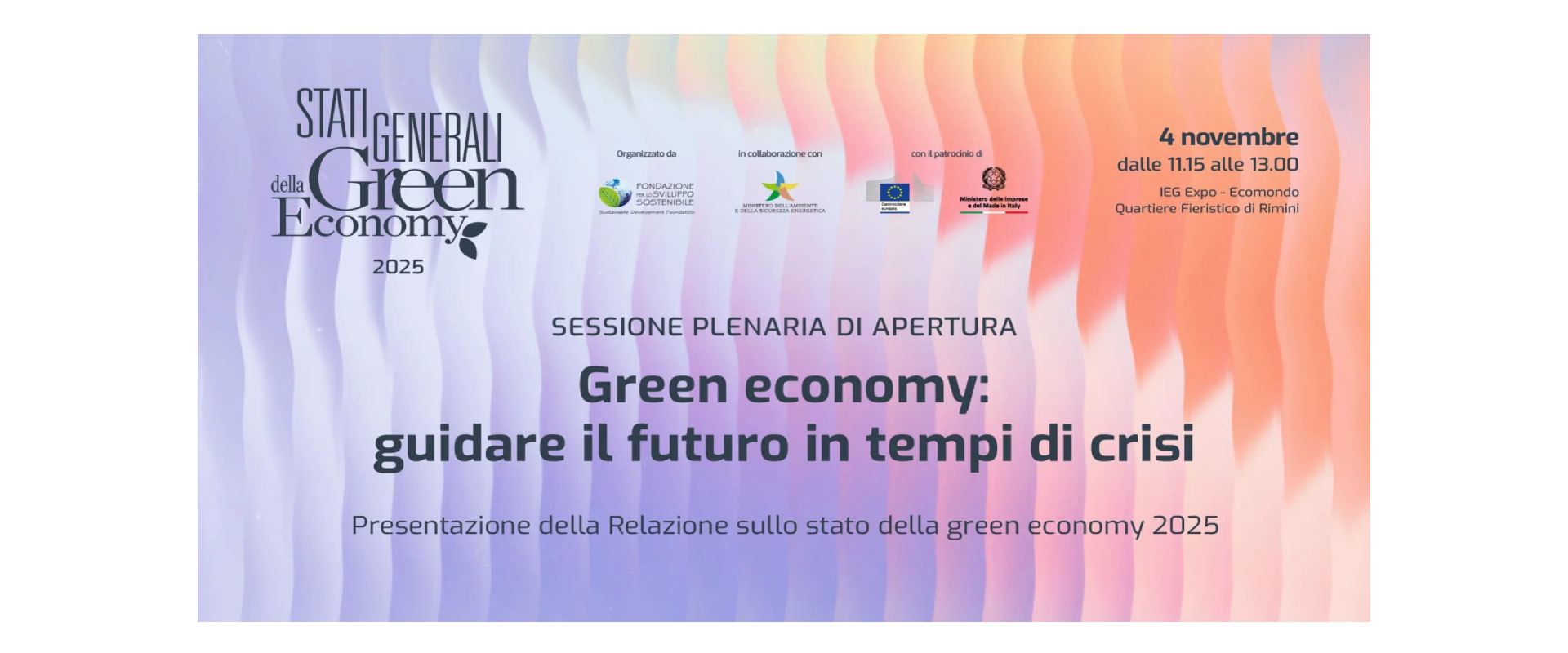
GREEN ECONOMY GENERAL ASSEMBLY 2025
The Green Economy General Assembly, run by the National Council for the Green Economy and by the Sustainable Development Foundation in collaboration with the Italian Ministry of the Environment and Energy Security, offered a detailed snapshot of the state of the green transition in Italy in 2025. The report, presented at Ecomondo on 4th November, highlighted the country’s two different sides: on the one hand, there were major results in certain key sectors; on the other hand, there were delays and critical issues that risk jeopardising environmental and climate goals.
Plus points: renewables, the circular economy and organic farming
Italy confirmed its leading position in the circular economy: in 2024, the waste recycling rate reached 86%, while resource productivity has grown by 32% since 2020. The production of electricity from renewable resources also accounted for 49% of the total, in line with the targets of the Italian Integrated National Plan for Energy and the Climate (PNIEC) for 2030. Furthermore, organic farming saw an increase of 2.4% in 2024, with over 2.5 million hectares cultivated according to organic standards, putting Italy in first place in Europe for the number of PDO, PGI and TSG products.
Downsides: emissions, land and mobility
Despite the progress made, pressing challenges still remain. Greenhouse gas emissions, although reduced by 28% since 1990, only fell by 1.8% in 2024, an inadequate rate for meeting the European target of -43% by 2030. Land consumption is showing no signs of stopping: in 2023, 64.4 km² of land was lost, at an average of 17.6 hectares per day. Lastly, sustainable mobility is struggling to take off: Italy leads Europe with 701 cars for every 1,000 inhabitants, with some of the oldest vehicles in circulation (average age of 12.8 years) and a percentage of electric cars languishing at 7.6%, compared with the EU average of 22.7%.
What the experts say
Edo Ronchi, President of the Sustainable Development Foundation, underlined how the green transition is not just an environmental choice, but an economic necessity: “Without the PNRR [Italian National Recovery and Resilience Plan], Italian GDP would be stagnating or in decline. For Italy, being at the centre of the Mediterranean climate hotspot, decarbonisation is vital”. Gilberto Pichetto Fratin, the Italian Minister for the Environment, highlighted the role of businesses: “Italy has what it takes to lead Europe towards a realistic transition based on energy security and innovation”.
Future prospects
The report underlined how energy efficiency, renewable energy development and circular models are essential not just for decarbonisation, but also for reducing energy costs and increasing the competitiveness of the country system. Thanks to PNRR funds, Italian cities are already running innovative projects for waste management, sustainable mobility and protecting urban green spaces. However, new forms of funding will need to be found from 2026 to support the green transition. A change of pace is needed to overcome critical issues and to take full advantage of the opportunities of this transition. The 2025 General Assembly confirmed that the road ahead is clear: it is now up to institutions, businesses and citizens to turn words into real action.
You can download the full report at: https://www.statigenerali.org/wp-content/uploads/2025/11/Relazione-sullo-stato-della-green-economy-in-Italia-2025.pdf
Plus points: renewables, the circular economy and organic farming
Italy confirmed its leading position in the circular economy: in 2024, the waste recycling rate reached 86%, while resource productivity has grown by 32% since 2020. The production of electricity from renewable resources also accounted for 49% of the total, in line with the targets of the Italian Integrated National Plan for Energy and the Climate (PNIEC) for 2030. Furthermore, organic farming saw an increase of 2.4% in 2024, with over 2.5 million hectares cultivated according to organic standards, putting Italy in first place in Europe for the number of PDO, PGI and TSG products.
Downsides: emissions, land and mobility
Despite the progress made, pressing challenges still remain. Greenhouse gas emissions, although reduced by 28% since 1990, only fell by 1.8% in 2024, an inadequate rate for meeting the European target of -43% by 2030. Land consumption is showing no signs of stopping: in 2023, 64.4 km² of land was lost, at an average of 17.6 hectares per day. Lastly, sustainable mobility is struggling to take off: Italy leads Europe with 701 cars for every 1,000 inhabitants, with some of the oldest vehicles in circulation (average age of 12.8 years) and a percentage of electric cars languishing at 7.6%, compared with the EU average of 22.7%.
What the experts say
Edo Ronchi, President of the Sustainable Development Foundation, underlined how the green transition is not just an environmental choice, but an economic necessity: “Without the PNRR [Italian National Recovery and Resilience Plan], Italian GDP would be stagnating or in decline. For Italy, being at the centre of the Mediterranean climate hotspot, decarbonisation is vital”. Gilberto Pichetto Fratin, the Italian Minister for the Environment, highlighted the role of businesses: “Italy has what it takes to lead Europe towards a realistic transition based on energy security and innovation”.
Future prospects
The report underlined how energy efficiency, renewable energy development and circular models are essential not just for decarbonisation, but also for reducing energy costs and increasing the competitiveness of the country system. Thanks to PNRR funds, Italian cities are already running innovative projects for waste management, sustainable mobility and protecting urban green spaces. However, new forms of funding will need to be found from 2026 to support the green transition. A change of pace is needed to overcome critical issues and to take full advantage of the opportunities of this transition. The 2025 General Assembly confirmed that the road ahead is clear: it is now up to institutions, businesses and citizens to turn words into real action.
You can download the full report at: https://www.statigenerali.org/wp-content/uploads/2025/11/Relazione-sullo-stato-della-green-economy-in-Italia-2025.pdf